
'The biggest point of contention is market access for US agricultural and dairy products.'

'Bilateral trade has suffered seriously because of the growing unrest.' 'There is a standstill on both sides amid the curfew.'

The tech community, which was getting ready to use the ChatGPT fever and raise unlimited capital for their businesses, is going to face tougher obstacles now, predicts Ajit Balakrishnan.

India and the UK will sign a free trade agreement on Thursday in London that will allow export of labour-intensive products such as leather, footwear and clothing at concessional rates, while making imports of whisky and cars from Britain cheaper. The pact also helps double trade between the two economies to $120 billion by 2030.

Union minister for textiles Dayanidhi Maran said, "The making of the National Fibre Policy is in its final stages and will be ready by March end." He spoke at a seminar today, organised by the Confederation of Indian Industry on textiles. He declined to divulge details.

'Geopolitically and diplomatically it's a very difficult situation for India.'

Commerce and Industry Minister Piyush Goyal will accompany Prime Minister Narendra Modi to London for the signing of the free trade agreement between India and the UK on July 24, an official said on Monday. The two countries announced the conclusion of the negotiations for the trade agreement on May 6.


The cash-starved Indian textile industry is of the view that the Technology Upgradation Fund Scheme, or Tufs, flagship scheme of the textiles ministry, has lost its shine, as economic slowdown has put modernisation and expansion plans of companies on hold. The industry says there are more basic problems that the government needs to address.

GST 2.0 may cushion consumers against US tariffs, but like the 2019 corporate tax cut, it risks being another tactical fix rather than a structural growth strategy, expects Debashis Basu.

'What India has done will surely embolden more countries to stand up to Trump.'
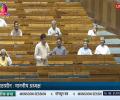
Commerce Minister Piyush Goyal assures Parliament that India will take necessary steps to protect its national interests following the US announcement of tariffs on Indian goods. The government is assessing the implications and engaging with stakeholders.
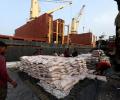
India has a comparative edge over key competitors in a majority of products it exports to the US and stands to gain market share as the US raises tariffs on its major trade partners, NITI Aayog said on Monday. In its quarterly trade report, it recommended that the government fast-track the India-US free trade agreement with time-bound goals to resolve non-tariff barriers and finalise digital trade rules on data flows and e-signatures to support services exports.

An Indian commerce ministry team has reached Washington for another round of talks from Monday on the proposed bilateral trade agreement (BTA), an official said. Chief negotiator of India and special secretary in the Department of Commerce, Rajesh Agrawal, will join the team on Wednesday.
According to industry estimates, textiles exports have declined by 6.8 per cent during the April-May period of 2007-08, while cotton yarn has seen a negative growth of 9.9 per cent. India's textile exports amounted to $19 billion last year and the target for this fiscal was set at $25 billion.
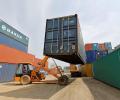
After registering a positive growth for two months, India's exports slipped into negative territory again, contracting 2.17 per cent year-on-year to $38.73 billion in May due to a fall in global petroleum prices, while trade deficit narrowed at $21.88 billion during the month.

India's merchandise exports dipped by about one per cent to $38.01 billion in December 2024 against $38.39 billion a year ago, according to government data released on Wednesday. Imports increased by 4.8 per cent to $59.95 billion in December 2024 compared to $57.15 billion in the year-ago month.
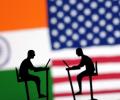
India and the US are likely to agree on an interim trade agreement before July 8 with New Delhi pushing for full exemption from the 26 per cent reciprocal tariff on domestic goods, an official said. The US on April 2 imposed an additional 26 per cent reciprocal tariff on Indian goods but suspended it for 90 days till July 9.
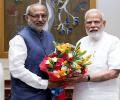
By naming a sworn swayamsevak for vice president, the Modi-Shah duo have sent out a clear and positive message to Nagpur, where the RSS headquarters is located, explains N Sathiya Moorthy.

'As the global economy undergoes significant transformations in 2025, India's ability to navigate the complexities of trade wars, financial realignments, and emerging blocs will be pivotal,' explain Harsh V Pant and Soumya Bhowmik.

'We don't have to compete with Maharashtra or Gujarat. We have to now start thinking about how we compete with the United States or China.'
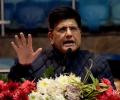
Commerce and Industry Minister Piyush Goyal will lead a team of senior Indian officials to Washington starting May 16 for discussions with their US counterparts on the proposed bilateral trade agreement (BTA), an official said on Tuesday. Goyal is expected to hold meetings with US Trade Representative (USTR) Jamieson Greer and US Commerce Secretary Howard Lutnick during his visit.

They saluted 'the hands that weave timeless stories'.
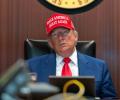
United States President Donald Trump said a 'very big' trade deal is on cards with India, hinting at significant progress in the negotiation process of a long-awaited bilateral trade agreement between the two countries.

'Could the impending new crisis, vibe coding, similarly create not a disaster like what befell Indian handlooms during the Industrial Revolution but another opportunity like what the Y2K crisis created?' asks Ajit Balakrishnan.

'The government's priority is not farmers.'

The commerce ministry is working on different scenarios to assess the possible fallout of reciprocal tariffs to be imposed by the US administration on April 2 on its key trading partners including India, sources said. US President Donald Trump has said that April 2 will be 'Liberation Day' as he plans to announce tariffs or import duties to bring down America's trade deficit, and promote the country's manufacturing.
A team of senior officials from India will again visit Washington this month to hold discussions with their US counterparts on the proposed bilateral trade agreement (BTA), government sources said on Thursday. To give impetus to the talks, India's chief negotiator Rajesh Agrawal, special secretary in the Department of Commerce, and Assistant US Trade Representative for South and Central Asia Brendan Lynch had last month held three-day talks in Washington.
It argued that the duty reduction will not lead to revenue loss for the government.

The Indian industry is paranoid about the USA's plan to impose reciprocal tariffs and wants early conclusion of a bilateral trade agreement, sources said on Wednesday. They said that the talks for the proposed bilateral trade agreement are going well.

'The package will help in realising the true potential of employment generation in the textile and apparel sector.'

From toys, footwear and furniture to insulated flasks, smart meters, and air coolers - the Central government over the last decade has mandated higher standards for production and imports of such items. Sample this: Till 2014, there were 14 Quality Control Orders (QCOs) covering 106 products. By the latest count, there are 156 QCOs on 672 products.
Indian textiles industry needs to restructure itself by evolving manufacturing and marketing strategies to take advantage of the likely addition of a $100 billion to world textiles trade, once the quota regime under WTO ends in 2004.

Another priority in the first 100 days could be the launch of an e-platform -- Trade Connect -- to help exporters connect with stakeholders of international trade.
The continued weak financial health of this sector remains one of the big enigmas of the post-liberalisation India.

Apparel exports have been declining on the back of rise in cotton and cotton yarn prices.
 © 2026 Rediff.com - Advertise with us - Disclaimer - Privacy Policy - Sitemap - Feedback - About us - Terms of use - Grievances